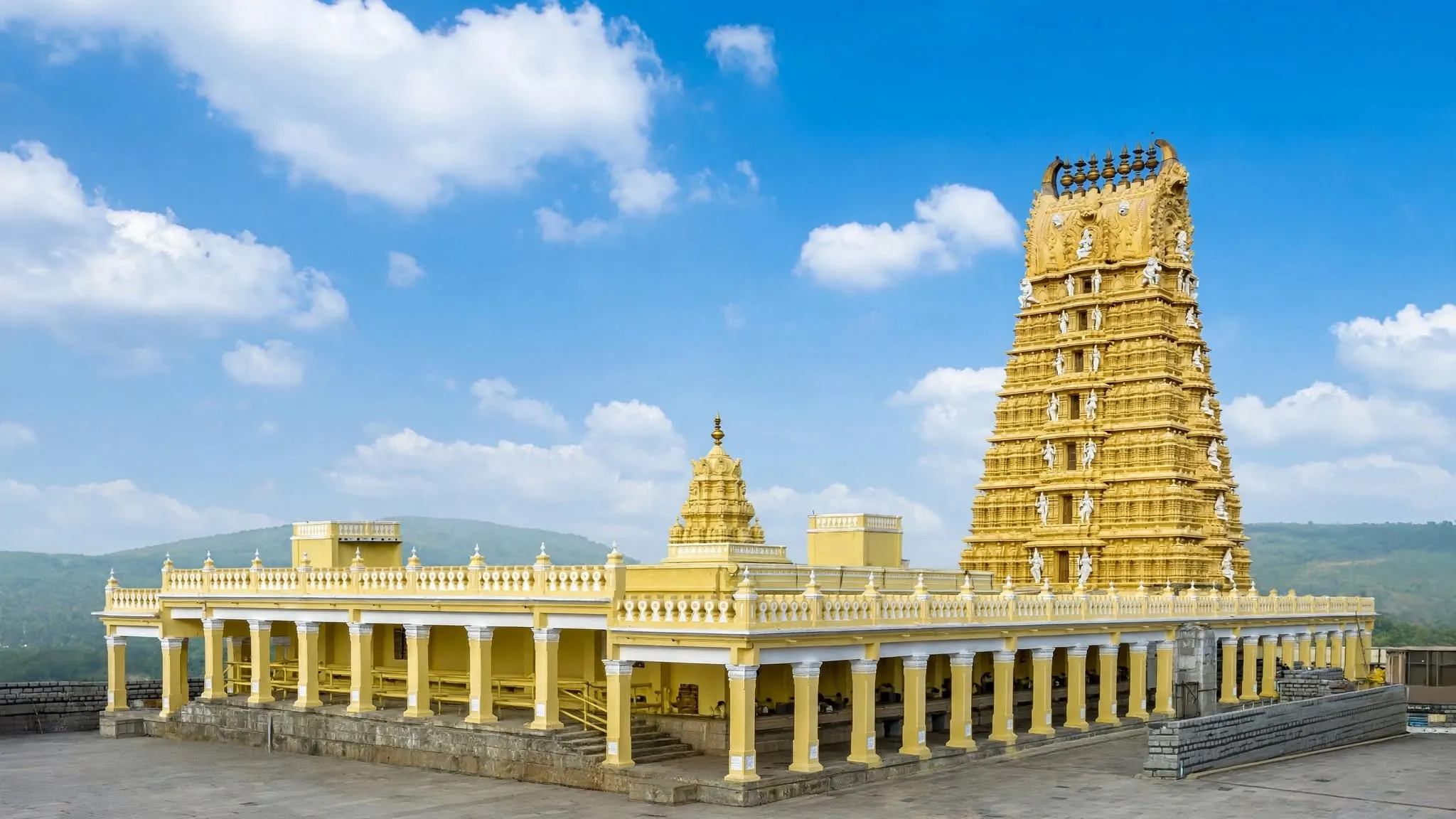
Sits on top of Chamundi Hills, approximately 13 km from Mysuru city center at an elevation of over 1,000 meters. Dedicated to Goddess Chamundeshwari—the tutelary deity of Mysuru and the royal family—the hill is a major spiritual and cultural landmark offering panoramic views of the city below.
Location: https://maps.app.goo.gl/QiiaacsjzmMD43Mb8
Regular Darshan & Temple Timings:
Morning: 7:30 AM – 2:00 PM
Afternoon: 3:30 PM – 6:00 PM
Evening: 7:30 PM – 9:00 PM
(Abhisheka timings: 6:00 AM – 7:30 AM and 6:00 PM – 7:30 PM; Fridays 5:00 AM – 6:30 AM)
Ticket Fares & Entry:
General Entry (Sarva Darshan): Free
Special Darshan: ₹30 to ₹100 per person (speeds up queue access; available at on-site counters and official portals)
Fast-track: ₹200 per person, can go upto 500 in peak hours.
VIP Darshan:
₹2000 per person
Dasara Timings & Arrangements (In Short):
Extended Hours: During the 10-day Dasara / Navratri festival, the temple opens significantly earlier (often starting around 5:30 AM) and darshan windows remain open for longer stretches into the night to accommodate large crowds.
Traffic & Access: Private vehicles are usually restricted or barred from driving up the hill during key Dasara days; visitors must take designated KSRTC shuttle buses operating continuously from the foothills (Lalitha Mahal ground or City Bus Stand).
Key Highlights for Visitors:
Mahishasura Statue: Located right near the summit bus stand.
Monolithic Nandi: A giant, 16-foot carved bull situated around the 700th step along the hill road.
Step Climb: Devotees and fitness enthusiasts can walk up the historic 1,008 stone steps from the base.
Beyond the Clouds of Mysuru: The Untold Story of Chamundi Hills
Most people know Chamundi Hills as the glowing silhouette towering over Mysuru, or the hill where thousands climb 1,008 stone steps every weekend. Long before it became a weekend getaway or an Instagram hotspot, this hill witnessed mythical showdowns, royal devotion, and a dramatic identity shift that gave the city of Mysuru its very name.
Here is the forgotten story carved into the granite of Chamundi Hills.
1. Before Chamundeshwari, It Was Shiva’s Mountain
If you think the famous Chamundeshwari Temple is the oldest structure on the summit, history has a surprise for you.
Centuries ago, locals knew this ridge as Mahabaladri (or Mabbala Betta), named after Lord Shiva in his form as Mahabaleshwara. The true architectural elder on the peak is the quiet, ancient Sri Mahabaleshwara Temple, standing since before the 12th century. Stone inscriptions reveal that in 1128 CE, the Hoysala ruler King Vishnuvardhana granted royal donations here—long before the hilltop transformed into the goddess shrine we recognize today.
2. The Demon, the Goddess, and the Name "Mysuru"
Ever wonder where the name Mysuru actually comes from? It begins atop this very ridge.
According to the Skanda Purana, the plains below were terrorized by the buffalo-headed demon king, Mahishasura. When no one else could defeat him, Goddess Durga took on her fierce warrior avatar: Chamundeshwari (Mahishasuramardini). After a furious multi-day clash on the rocky slopes, she struck him down.
The liberated kingdom was christened Mahishooru—"The Realm of Mahishasura"—which rolling centuries softened into Mysore, and ultimately returned to Mysuru.
3. The Royal Touch: How the Wadiyars Carved a Legend
Chamundi Hills shifted from a rugged, dense jungle into a sacred crown jewel under the Wadiyar dynasty, who revered the Goddess as their guardian family deity (Kula Devatha).
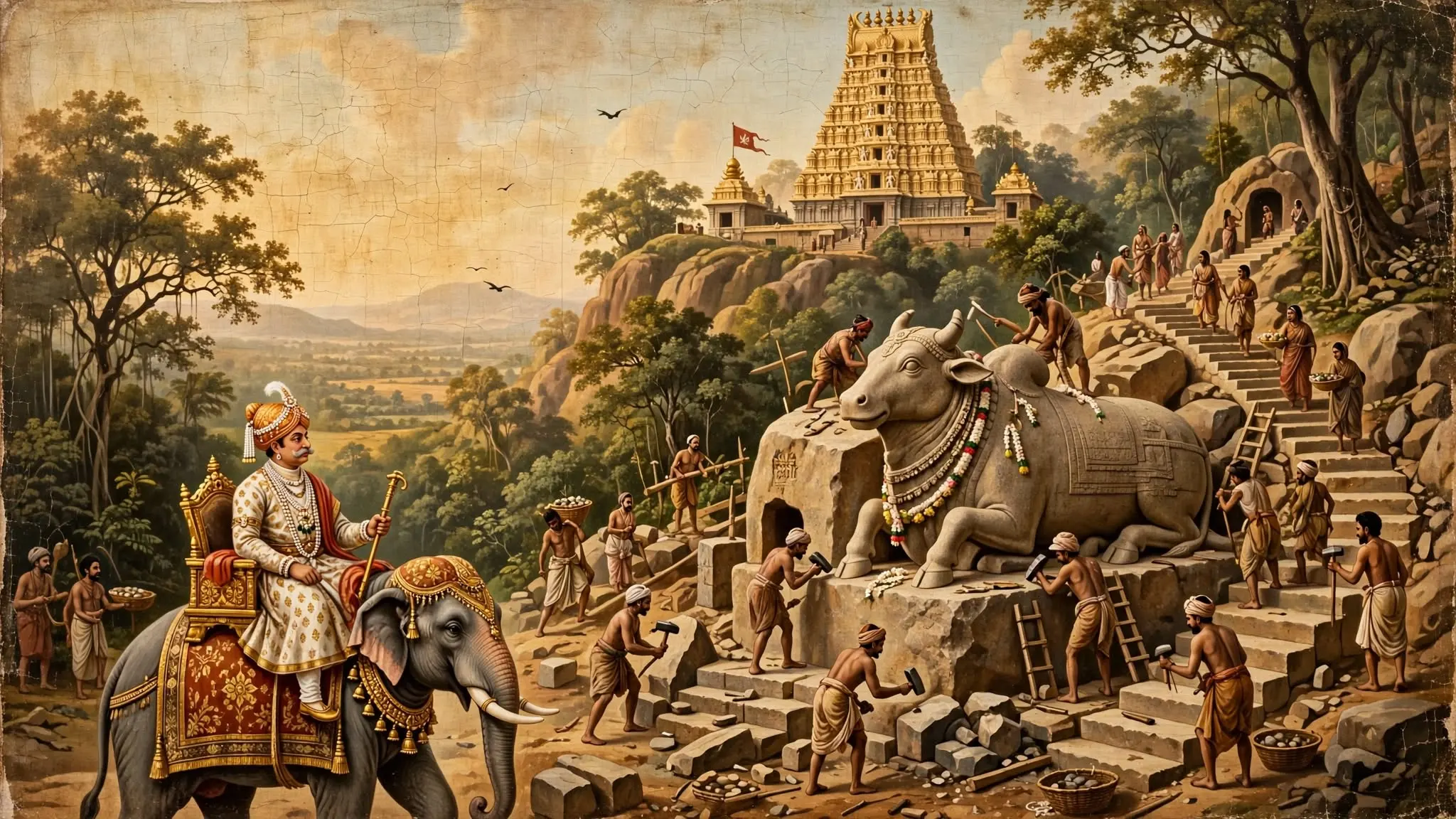
1,008 Steps & a Giant Bull (1659–1664): Maharaja Dodda Devaraja Wadiyar carved 1,008 stone steps out of the raw hill face to give pilgrims a path up. At roughly the 700th step, he had artisans carve an entire granite boulder into the Monolithic Nandi—over 16 feet tall and 25 feet long, still draped in bells and garlands today.
The Golden Crown of 1827: The towering seven-tiered Rajagopuram that dominates the skyline today was commissioned by Maharaja Mummadi Krishnaraja Wadiyar III, who crowned the entrance with golden finials (Kalashas) and showered the shrine with priceless gems.
4. From Royal Retreat to Dasara’s Epicenter
By the 20th century, smooth winding roads replaced dirt tracks. The Maharajas built Rajendra Vilas Palace high on the ridge as a breezy summer sanctuary overlooking the entire valley. Soon after, the colorful, mustache-twirling statue of Mahishasura—sword in one hand, cobra in the other—was raised near the summit bus stand, becoming one of Karnataka's most iconic landmarks.
Today, Chamundi Hills is a vital reserve forest ringed with wildlife, panoramic view decks, and the spiritual anchor of the world-renowned Mysuru Dasara, where grand royal rituals begin every autumn.
Pro-Tip for Visitors & Photographers
The Heritage Route: Skip the road once and try the 1,008-step climb at dawn. You will cross paths with wild peacocks, get up close with the monolithic Nandi at the 700th step, and watch the morning mist lift off Mysuru Palace below.
SEO Tags:
chamundi hills
chamundi betta mysore
chamundeshwari temple timings
chamundi hill ticket price
chamundeshwari temple special darshan
chamundi hills entry fee
chamundi hills opening hours
places to visit in mysore
chamundi hills viewpoint
chamundi hill steps climb
nandi statue chamundi hills
mahishasura statue mysuru
how to reach chamundi hills
mysore sightseeing itinerary
chamundi hills ksrtc bus timings
chamundi hills dasara timings
mysore dasara temple timings
chamundeshwari temple navratri darshan
mysore dasara shuttle bus chamundi hill
how many steps in chamundi hills
is private vehicle allowed on chamundi hills during dasara